
Type 2 Charging Cables: Choosing a Lead for Public AC Charging
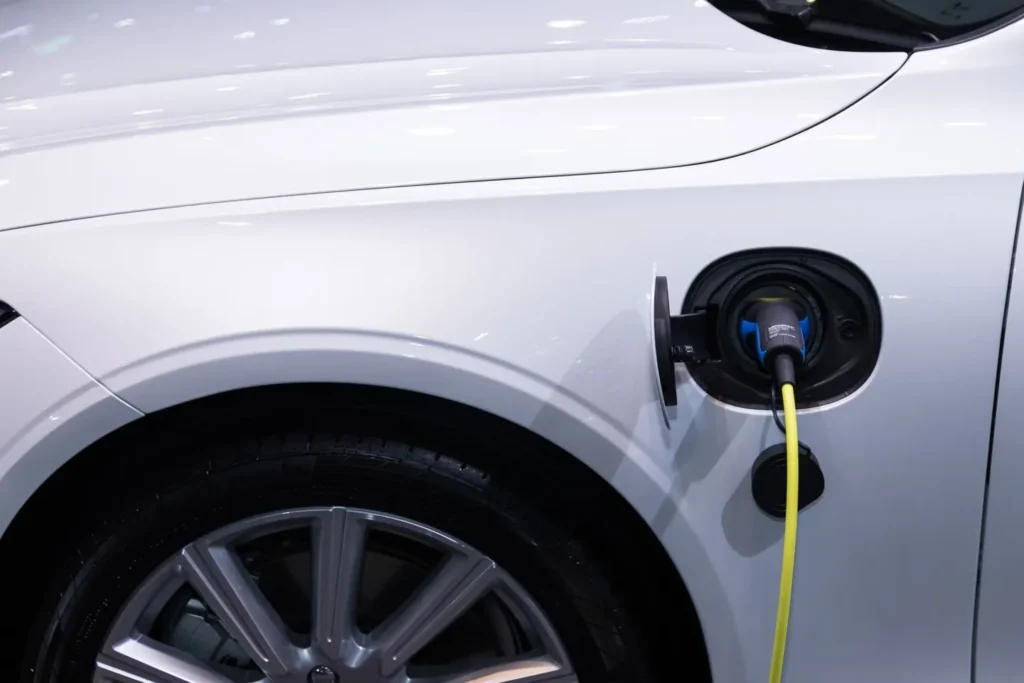
Carry a suitable Type 2 cable when your planned public AC charger has a socket rather than an attached lead. Check the individual site before travelling. Some AC chargers supply a cable; others require yours. A cable that fits the post must also match your vehicle and its supported charging mode.
By EV Charger Near Me Team. Reviewed 2 November 2026.
Check the socket before buying a cable
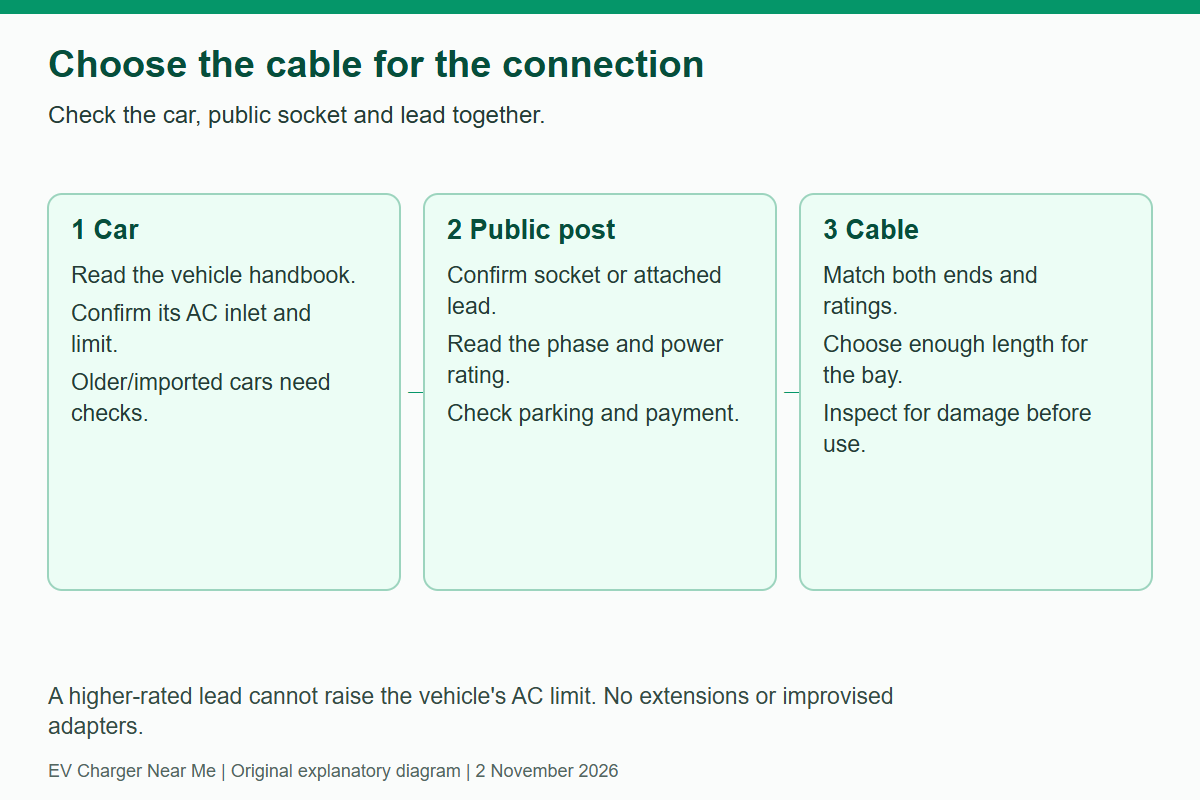
The Australian Government’s charging-equipment guide identifies Type 2 as the usual Australian AC connection. It also distinguishes CCS2 and CHAdeMO DC charging. Identify your car’s inlet in its handbook; an older or imported vehicle may need a different compatible lead.
An untethered Type 2 post normally needs a Mode 3 cable with the correct connector at each end. A portable unit with a household plug is different equipment. Your AC cable does not turn an AC socket into a DC charger, and it is not a substitute for a DC charger’s attached lead.
Match the cable rating to the vehicle and supply
| What to check | Why it matters |
|---|---|
| Vehicle AC limit and supported phases | The onboard charger limits how much AC power the car can use. |
| Post rating and available supply | The post may offer less power than the cable can carry, or share a limited supply. |
| Cable current, phase and connector ratings | The lead must support the connection you intend to use. Confirm its specifications with the supplier and vehicle guidance. |
| Length and reach within the marked bay | The lead should reach without tension, crossing a traffic lane or creating a trip hazard. |
A higher-rated cable cannot increase the car’s onboard charging limit. Nor does a cable marked 22 kW guarantee 22 kW at every post. For example, Tesla’s Australian Type 2 cable specifications describe different maximums by vehicle configuration. Check your exact model rather than treating a brand or model family as one specification.
Choose a practical length and inspect the lead
Use the shortest lead that comfortably reaches the expected socket from your car’s charging port. Consider whether the bay requires reversing in and where the post sits. Do not solve a short lead by parking across another bay or improvising an extension or adapter.
Follow the cable manufacturer’s instructions for storage, weather exposure and inspection. An ingress-protection rating is not a promise that a cable can safely be run over. Do not use damaged plugs, split insulation or equipment that has suffered an impact until it has been assessed appropriately.
Buy through an identifiable supplier that can document the product’s suitability and applicable electrical compliance. AS/NZS 3000 is the Wiring Rules for installations; a claim that a loose cable is “certified to the Wiring Rules” is not enough to establish its product compliance. Requirements for equipment and installations are different checks.
Connect and release it using the actual equipment’s instructions
Read the station’s connection and payment sequence. Insert the correct ends fully without forcing them, start the session using its supported method and confirm that charging has begun. The car and station may lock the cable during the session.
To disconnect, stop the session normally, confirm it has ended and follow the vehicle’s unlocking procedure. Chargefox’s stuck-cable instructions say to check that charging has stopped and contact support if the station still holds the cable. The vehicle manual governs its own release mechanism. Do not use an emergency stop as a routine cable-release shortcut or pull harder on a locked connector.
Check what is already in the car
New-car inclusions vary by model, market, order and promotion. Used cars may be missing an originally supplied lead. Check the boot, purchase documents and manufacturer’s current specification before buying. A domestic portable charger and a public Type 2-to-Type 2 cable are different items.
Find candidate AC stops on the charger map, then confirm cable requirements with the operator or venue. The connector guide explains the AC/DC distinction; the session walkthrough covers start, check and stop.
Compare public charging stops
Compare recorded connectors, power and access, then confirm current details with the operator.
Related guides


Need another charging stop?
Browse recorded charging locations or read more guides on using public equipment.
Find EV chargers All guides