
EV Charging Etiquette: Queues, Shared Bays and Finishing a Session

Good charging etiquette means following the site’s queue and parking rules, keeping access clear and moving when your session is finished. Choose suitable equipment for the energy you need and the time you can stay. Public fast charging is useful to local residents as well as travellers.
By EV Charger Near Me Team. Reviewed 2 November 2026.
Choose equipment that suits your visit
An AC post may cover the energy needed during a longer shop or hotel stay. A compatible DC unit may be appropriate when time is limited. A driver without home charging can reasonably need DC near home; a road-trip badge does not give another driver automatic priority.
Compare usable power, available time and parking conditions. If a suitable slower option meets your needs while faster bays are busy, taking it can help everyone. Do not assume it meets another driver’s needs or demand that they move an active session solely because they live locally.
Queue without blocking the site
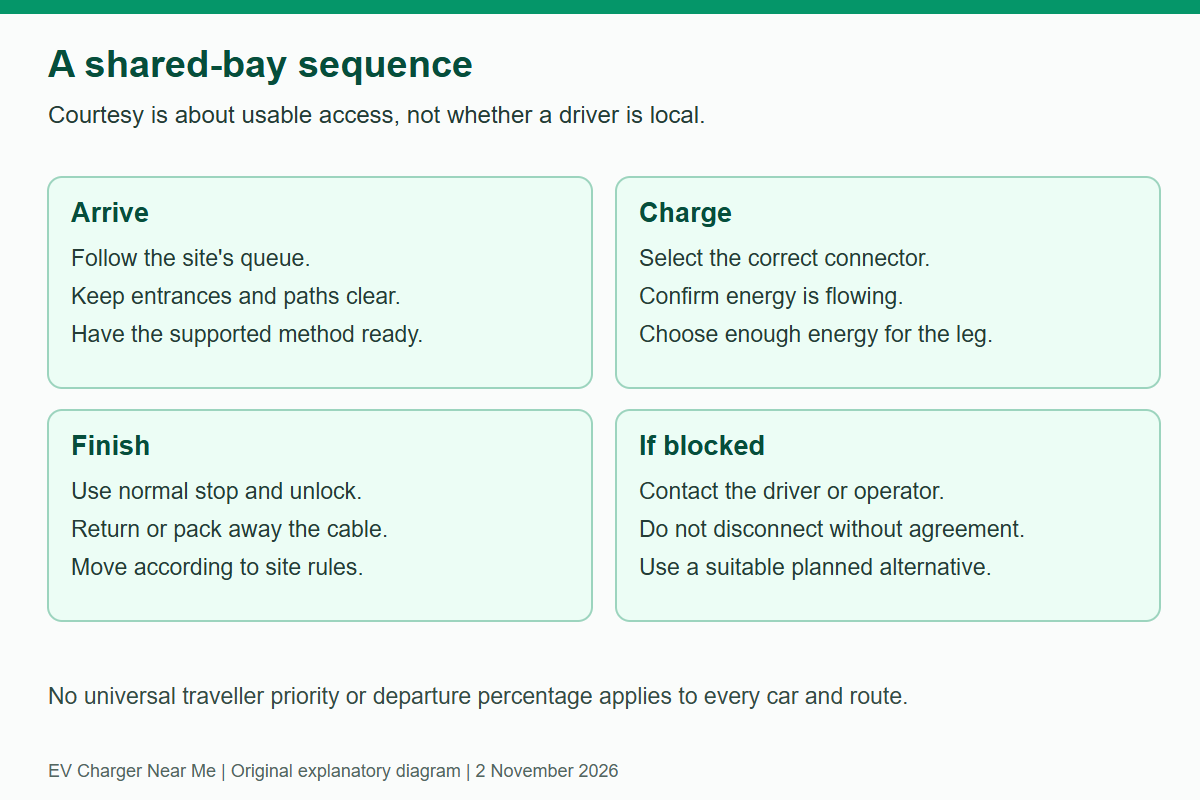
Use a marked queue if one exists. Otherwise follow the site’s instructions, keep traffic and pedestrian routes clear and communicate politely with waiting drivers. Do not invent a queue position by obstructing an entrance or occupying an unrelated bay.
Prepare the supported app or card before reaching the charger. Once parked, select the correct station and connector, follow the prompts and confirm energy is flowing. If a fault needs support, note the unit ID and make room where possible without creating another obstruction. A charger may need an operator’s assistance rather than repeated unexplained restarts.
Decide when you have enough energy
Use the vehicle’s guidance and your next leg to choose a target with a sensible reserve. Charging often slows as the battery fills, but there is no single departure percentage suitable for every car and route. A longer regional leg may justify more energy; an unnecessary final top-up at a busy site may keep others waiting.
Check the site’s own fee triggers. For example, Tesla’s congestion conditions can apply at a busy site before the battery is full. Evie’s terms separately describe idling charges after charging finishes. These are operator rules, not one universal 80% etiquette law.
End your own session and leave the cable safely
Stop through the normal control for your payment method, confirm the session has ended and follow the car’s unlocking instructions. Return a tethered connector to its holder. Put your own AC cable away without leaving loops across a walkway or neighbouring bay.
Do not force a stuck connector or use an emergency stop as a routine release. Chargefox’s release guidance directs drivers to check session status, follow vehicle instructions and contact support where needed.
Do not disconnect someone else’s car without agreement
A full-looking battery or an idle indication is not permission to handle another person’s equipment. Ask the driver or venue/operator for help and follow the site’s policy. Do not interrupt an active session or try to defeat a cable lock.
At accommodation, agree with reception or other drivers about any permitted swap. See destination charging for overnight arrangements. A room booking does not automatically reserve a charging bay.
Report blocked bays calmly
Parking signs and applicable rules determine whether a bay requires active charging or has other restrictions. Read the signs rather than assuming every space beside a post has identical legal conditions. Report a blocked bay to the venue or responsible parking authority with its location and relevant signage.
Avoid confrontation and do not touch another vehicle. If you cannot use the stop, check a planned alternative you can reach. Use the charger map for candidates, then confirm their current operator details.
The session walkthrough covers the practical sequence. For fees and payment methods, use the payment guide. Clear communication, safe cable handling and a prompt departure when finished are useful at every network.
Compare public charging stops
Compare recorded connectors, power and access, then confirm current details with the operator.
Related guides


Need another charging stop?
Browse recorded charging locations or read more guides on using public equipment.
Find EV chargers All guides